Build your week in a minute
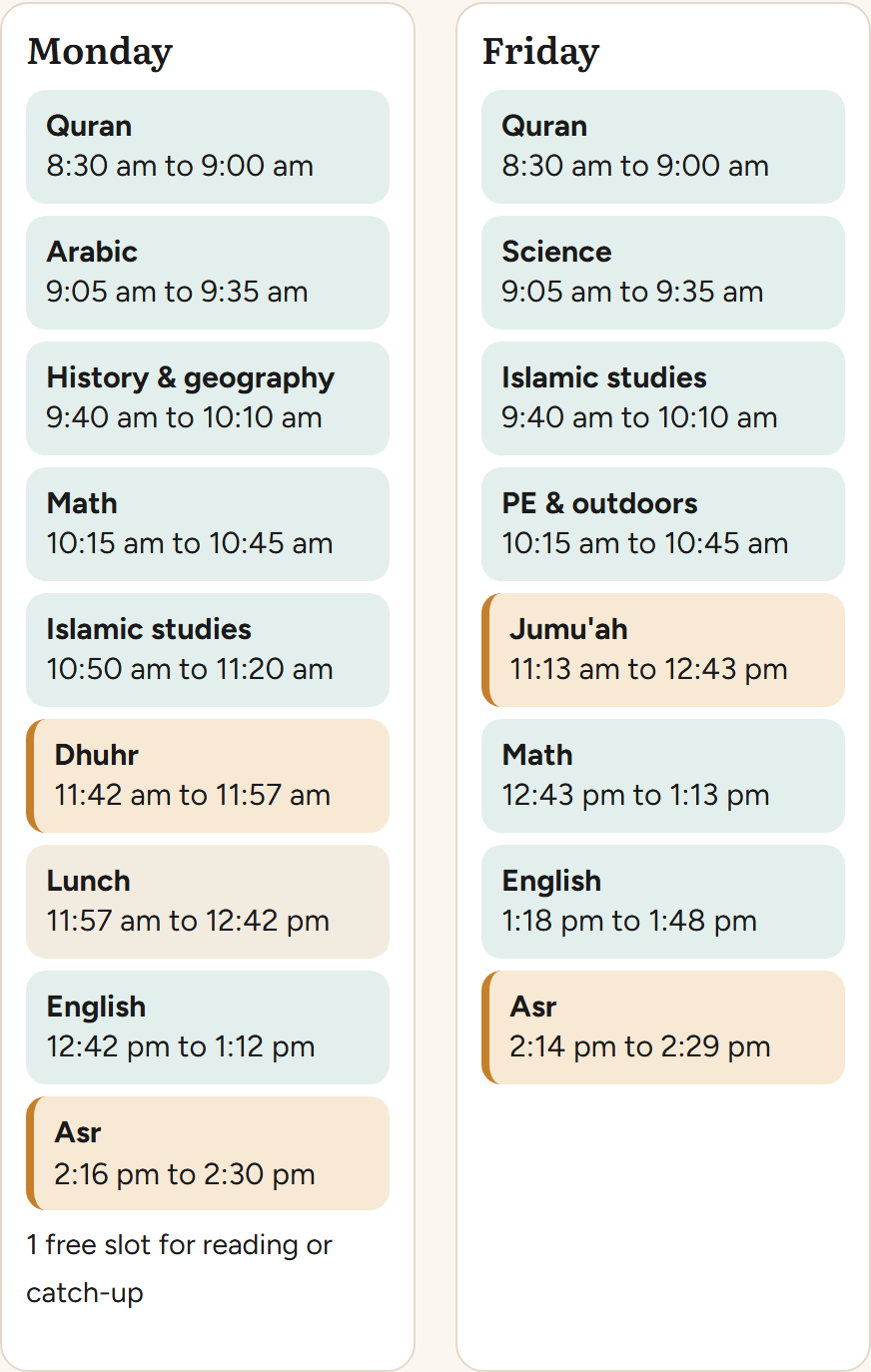
Prayer times change through the year, so a fixed clock schedule slips. The easiest fix is to let a tool do the arithmetic. Our free schedule builder builds a school week around your local prayer times. If you prefer paper, the printable homeschool planner gives you a blank weekly grid to fill in.
The tables below show the shape of a day rather than exact clock times, because Dhuhr and Asr are at different clock times in Phoenix, Manchester and Toronto, and they shift through the year.
The pattern behind every sample
Many Muslim homeschool days follow a similar rhythm:
- After Fajr: Quran, quiet reading or a short family time.
- Morning: The hardest subjects, when minds are freshest.
- Before Dhuhr: Lighter lessons, wrap up.
- Dhuhr: Pray, eat, rest.
- After Dhuhr: One or two lighter blocks.
- Before Asr: Finish, tidy, pray Asr.
- After Asr: Outdoor time, reading, projects, chores.
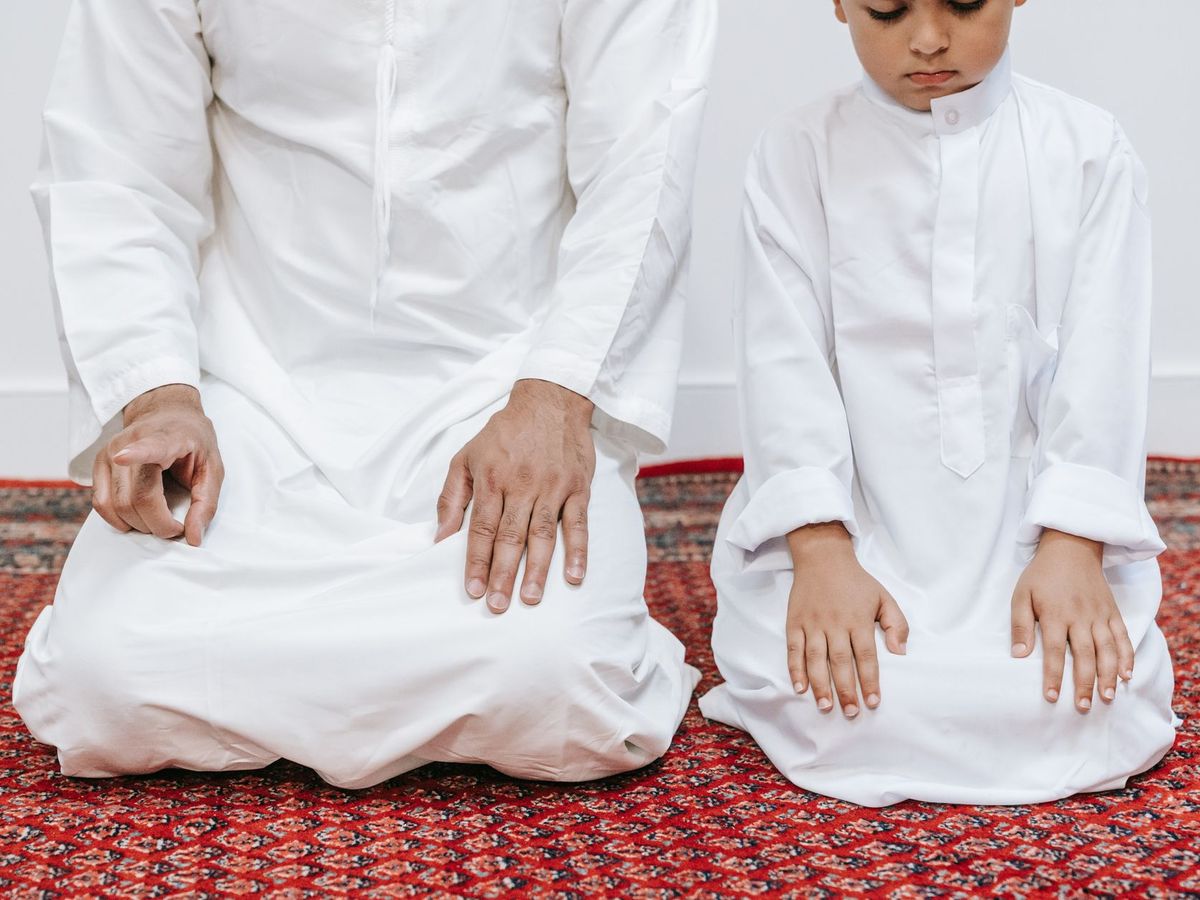
Teaching your children to pray at each of these breaks is covered in our guide to teaching salah to children.

Ages 4 to 6: short blocks, lots of movement
Young children learn best in short bursts with plenty of play. A few focused blocks of 10 to 20 minutes are often enough. These blocks are suggestions, not required hours. For the full age 3 to 5 plan, see the preschool guide.
| Block | What happens |
|---|---|
| After Fajr | Quiet time, listening to a surah, a short dua |
| Breakfast | Together, chores such as setting the table |
| Morning block 1 | Letters and sounds, or early reading |
| Morning block 2 | Numbers: counting, patterns, games |
| Movement break | Outdoors, stretching, play |
| Morning block 3 | Story time, Quran or seerah story |
| Dhuhr | Wudu and prayer together, lunch |
| Rest | Quiet play or a nap |
| Afternoon | Art, nature, crafts, hands-on activity |
| Asr | Prayer together |
| After Asr | Free play, outdoors, helping at home |
Ages 7 to 10: a steady rhythm
Children this age can work in longer blocks of 20 to 40 minutes. They also benefit from a visible schedule they can check.
| Block | What happens |
|---|---|
| After Fajr | Quran reading and revision |
| Breakfast | Family time |
| Morning block 1 | Math |
| Morning block 2 | Reading and writing |
| Break | Outdoors or snack |
| Morning block 3 | Science, history or geography (rotate days) |
| Before Dhuhr | Islamic studies: seerah, duas or Arabic |
| Dhuhr | Prayer, lunch, rest |
| Afternoon block 1 | Project work, art or a topic of the child’s choice |
| Afternoon block 2 | Independent reading |
| Asr | Prayer |
| After Asr | Sports, play, chores |
For ideas on what goes into the Islamic studies block, see our Quran plan.
Ages 11 to 14: more independence
Older children can handle longer blocks and some independent work. They may also have outside classes, co-op days or exam preparation. Give them ownership of their own timetable.
| Block | What happens |
|---|---|
| After Fajr | Quran memorization and revision |
| Breakfast | Family |
| Block 1 | Math |
| Block 2 | English: reading, writing, grammar |
| Break | Walk, snack, prayer if the time falls here |
| Block 3 | Science or history (alternate) |
| Block 4 | Islamic studies, Arabic or a second language |
| Dhuhr | Prayer, lunch, rest |
| Afternoon block 1 | Independent project or elective |
| Afternoon block 2 | Catch-up, review, planning tomorrow |
| Asr | Prayer |
| After Asr | Sports, hobbies, volunteering, chores |
At this age, ask your child to help write the schedule. A plan they helped build is more likely to be followed.

Winter and summer
Prayer times move through the year, and the gap between prayers changes with them. A few practical points:
- Winter: The day is shorter and Dhuhr and Asr come closer together in many places. Expect fewer hours between them. Put the hard lessons early and keep the afternoon for hands-on work.
- Summer: Days are longer, with more space between prayers. Use the extra daylight for outdoor learning and trips, and keep a regular wake time so Fajr stays manageable.
- Check weekly. The times can move by a minute or more each day in some seasons. A weekly glance, or a tool that does it for you, prevents surprises. The schedule builder is built for this.
- Ramadan. The whole schedule changes. See our Ramadan homeschool plan.
Fridays and Jumu’ah
Many families make Friday different. A common pattern:
| Block | What happens |
|---|---|
| Morning | Two short lessons: one core subject and a review |
| Late morning | Chores, bath, clean clothes, getting ready for Jumu’ah |
| Before Jumu’ah | Read or listen to a Quran portion, or a short surah revision |
| Jumu’ah | Go to the masjid as a family if you can |
| Afternoon | Free time, family time, outings or a co-op |
Some families use Friday as a field-trip day or a weekly review day. If your family keeps a different weekend, move the pattern to fit.
Making it work
- Start with the prayers, not the subjects. Put the prayers on the grid first, then fit lessons around them.
- Do not fill every slot. Empty space is part of the plan.
- Review each month. If a block is always rushed, lengthen it. If a child finishes early, add something or end the block.
- Be flexible on hard days. A sick child, a visitor or a long drive does not mean failure. Pick up the next morning.
For help with the bigger picture, see our guide to the Islamic homeschool year, and then use the schedule builder to place your first week on a grid.
Adapting the samples to your household
The tables above assume one parent teaching in a quiet house. Real homes are busier. A few changes that help:
- Several ages at once. Put the youngest on a short, hands-on block while the older children do independent work. Bring everyone together for Quran, read-aloud and prayer.
- A parent who works. Move the core lessons to the hours when a parent is free, and give the other times to independent reading, projects and online classes your family has chosen.
- A different weekend. If your week runs Sunday to Thursday, or your weekend is Friday and Saturday, shift the pattern. The shape of the day stays the same.
- Outside classes. Co-op days, sports and Quran classes take up whole blocks. Treat them as fixed points and plan the rest around them.
- Low-energy days. Keep a short list of “minimum day” activities: reading aloud, a short Quran session, a walk. That keeps the rhythm going without a full timetable.
A weekly check-in
Once a week, sit down for ten minutes and look at the plan:
- Which blocks ran on time, and which were always rushed?
- Did every prayer have a calm space around it?
- Is anyone asking for more time on something, or less?
- What is one change for next week?
Small changes made weekly work better than a big overhaul made twice a year. If you want to see how the whole year fits together, read our page on the Islamic homeschool year.
Common questions
How many hours a day should a Muslim homeschool take?
It depends on the age of the child, your state or country's rules and your goals. The samples here are a starting point. Younger children usually need much shorter focused blocks than older ones. Check your local homeschool rules for any required hours.
How do we plan school around prayer times that change?
Anchor the day to the prayers rather than to the clock. Dhuhr and Asr become natural breaks. Check the times weekly, or use our schedule builder, which lays out a week around your local prayer times.
Should school run on Friday?
Many families keep Friday lighter so there is time to prepare for Jumu'ah. The Friday note below shows one way to do it.
Can I use a different weekend, such as Friday and Saturday?
Yes. Some Muslim families take a different weekend or a Sunday to Thursday week. The tables are easy to move around.